

The Things You Notice That Others Don’t
How small observations shape ethics, storytelling, and human connection

Over Christmas, I had a chance to leaf through one of my grandmother’s old schoolbooks. The pages were filled with her handwritten pencil notes: checkmarks, Xs marking what might have been required reading, and even a tiny face with its nose pointing up toward the page number, drawn around Antigone’s direction “Exit Teiresias.” Some of the notes were so faded I had to squint to make out the words.
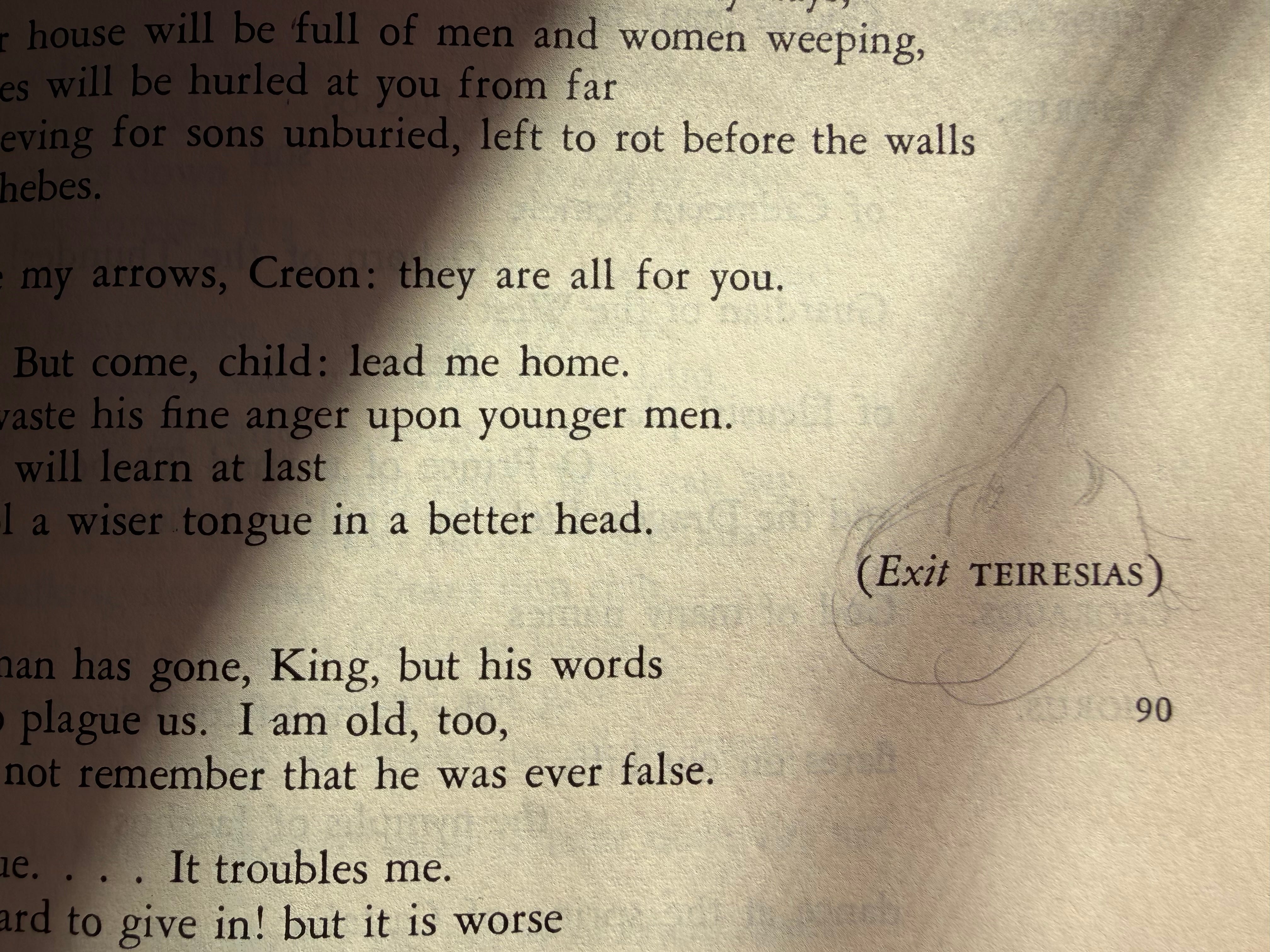
I’ve never been comfortable writing inside books myself. Recipes get sticky notes tucked inside with reminders for next time. I hated when I got a used textbook that was just a mass of highlighters, but I appreciated previous owners who wielded fluorescent colors with surgical precision. The only non-textbook I can remember breaking my personal rules for was when I studied Joyce’s Ulysses in graduate school. Even then, I hesitated. Writing inside someone else’s work feels like leaving a trace on someone else’s mind, delicate and permanent in a way that a Post-it note is not.
These small marks matter. They show what someone paused to notice, what they wrestled with, and what they cared enough to preserve. But they also reveal where the mind wandered, where curiosity, humor, or imagination took over—a tiny doodle in the margin, a sideways note, a flourish that doesn’t relate directly to the text. Like medieval manuscripts or monks’ copied texts, the margins tell a story beyond the main words. They are fragments of thought that survive long after the moment has passed, evidence that someone engaged deeply with the world in all its seriousness, whimsy, and unpredictability.
In my communications work, I’ve realized that the small details we observe carry as much weight as the notes in the margins of a book. It’s easy to write a newsletter, a report, or a policy update. It’s harder to notice the hesitation behind a question in a meeting, the tone that signals a concern before it’s spoken, or the details that make someone feel seen and understood. It’s even harder to see the small, playful, human moments that may not seem “relevant” but influence how people experience information. These are not items on a project plan, but they are the threads that shape trust, engagement, and connection.
Some days, noticing feels like a superpower. Other days, it feels like a weight: the responsibility of understanding context, knowing when and how to act, and seeing what others overlook. The quiet gestures, the small marks, the subtle pauses—the doodles, the wandering thoughts—are the things that carry meaning across time. They shape culture, build relationships, and preserve the story of who we are, often more than any metric ever could.

Why does this matter? In a world increasingly driven by speed, data, and automation, the things humans notice that machines or processes miss are rare and valuable. Empathy, discernment, and thoughtfulness cannot be captured in a spreadsheet or replicated by AI. They allow us to interpret context, respond ethically, and preserve meaning. They turn information into understanding, and tasks into relationships.
As communicators, writers, and humans, noticing is more than a skill—it is a responsibility. The way we record, highlight, and share information carries consequences. We decide what deserves attention and what might be left unsaid. We shape the stories others will read and the truths they will take away. Each choice is an ethical one: to simplify or obscure, to amplify or ignore, to document or forget. Noticing is the first step; thoughtful, conscientious action is what gives it weight.
The pencil marks in my grandmother’s books remind me that noticing is not just about attention. It is about care, intention, and memory. The notes we make, the gestures we recognize, the pauses and doodles we honor—they are what make our work, our connections, and our stories human. AI can flag errors, summarize data, and even suggest language. But it cannot feel the hesitation behind a question, remember the quiet act of courage, or preserve the fragments that truly tell the story.
What small moment, unnoticed at the time, has stuck with you? A detail that revealed care, courage, or truth? I would love to hear your fragments—the ones worth preserving.
— Sarah
Writer, human-behavior spy, and reluctant highlighter.
Related Reading
If you’re interested in how noticing the small, human moments shapes the work we do and the stories we tell, you might enjoy a couple of past pieces:
Fragments of Memory, Pages of History — A reflection on what archives preserve, what they leave out, and how even tiny details can reveal care, intention, and the values of a moment.
Change Fatigue and the Myth of Buy-In — Thoughts on the emotional side of organizational change and why noticing what’s unsaid or subtle can make all the difference in building trust.
These pieces explore the same thread: how attention, observation, and intentionality carry meaning across time, whether in books, in organizations, or in our daily work.